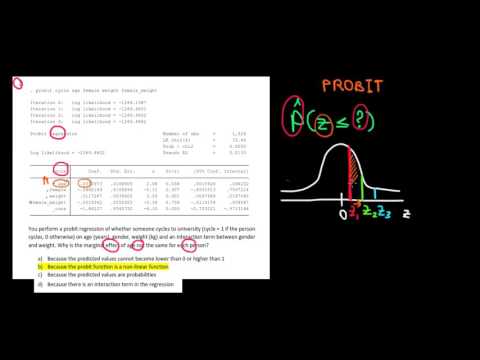
So, hey! You ever heard of probit regression? Sounds fancy, right? But it’s really just a cool way to analyze data when you want to understand binary outcomes. You know, like yes or no, success or failure.
Este blog ofrece contenido únicamente con fines informativos, educativos y de reflexión. La información publicada no constituye consejo médico, psicológico ni psiquiátrico, y no sustituye la evaluación, el diagnóstico, el tratamiento ni la orientación individual de un profesional debidamente acreditado. Si crees que puedes estar atravesando un problema psicológico o de salud, consulta cuanto antes con un profesional certificado antes de tomar cualquier decisión importante sobre tu bienestar. No te automediques ni inicies, suspendas o modifiques medicamentos, terapias o tratamientos por tu cuenta. Aunque intentamos que la información sea útil y precisa, no garantizamos que esté completa, actualizada o que sea adecuada. El uso de este contenido es bajo tu propia responsabilidad y su lectura no crea una relación profesional, clínica ni terapéutica con el autor o con este sitio web.
Picture this: you’ve got a bunch of students and you’re trying to figure out who will pass that big exam. Probit regression can help you predict who’s gonna make it based on some other factors—like study habits or attendance. Pretty neat, huh?
It’s all about looking at the relationships between your variables in a way that makes sense for those yes-or-no questions. No complicated stuff here—just a straightforward method to help make sense of what might seem random at first glance.
So let’s break it down together! You in?
Understanding the Assumptions of Probit Regression: Implications for Psychological Research
Probit regression might sound like a fancy term, but it’s really just a way for psychologists and other researchers to analyze data that involves binary outcomes—like yes/no decisions. Think of it as a tool to help predict probabilities when you’re dealing with things that don’t fit into simple categories.
Assumptions of Probit Regression are crucial to make sure your results are solid. Basically, these assumptions set the stage for how accurately you can interpret your data. Let’s break them down:
- Normality: The errors in the model should be normally distributed. This means if you were to plot them out on a graph, they’d form a bell-shaped curve. If they look wonky, your results might skew too!
- Independence: Observations must be independent of each other. Imagine if you were surveying players in a game—but if their responses influenced one another (like teammates!), it could mess things up.
- Linearity: There needs to be a linear relationship between the independent variables and the probability of being in one of the two categories. It’s kind of like making sure the path in a video game is clear; if it gets too twisty, you might lose track!
- No extreme multicollinearity: This fancy word just means that predictors shouldn’t be too closely related or correlated with each other. If they are, it can confuse what variable affects the outcome most clearly. You wouldn’t want to accidentally give double points for something in a game, right?
- Sufficient sample size: Lastly, having enough data points is critical! A tiny sample could lead to unreliable conclusions—like trying to judge whether everyone loves pizza based on just three friends’ opinions.
Let’s talk about why these assumptions matter. If one or more of them is violated, your model’s estimates might not reflect reality accurately. For example, imagine conducting research about whether people feel happier after playing video games versus reading books. If you’re not careful about these assumptions and use flawed data or methods, you could end up concluding that video games make people miserable when really it’s just that those specific players had bad experiences.
Another important point? Your outcomes depend heavily on how well these assumptions hold up! If everything’s aligned nicely with them, then your model can legit predict probabilities pretty well—kind of like calculating odds before placing bets in a game.
In psychological research , probit regression helps examine complex behaviors and decisions where responses are often binary—like choosing between two types of therapy methods or preferences for different activities. The key takeaway here is that understanding these assumptions will ultimately lead to more credible insights into human behavior.
If you’re diving into this area yourself? Just remember: while probit regression is powerful, it’s not magic! Always consider seeking help from professionals when necessary because interpreting data can get intricate—even with solid methods backing you up!
Understanding the Key Differences Between Linear Regression and Probit Regression in Data Analysis
Sure thing! Let’s chat about the differences between linear regression and probit regression in a way that makes sense without diving deep into math jargon. Both of these are types of statistical modeling, but they serve different purposes.
Linear Regression is a method used when you want to predict a continuous outcome. For example, let’s say you’re trying to predict someone’s final score in a video game based on the number of hours they’ve practiced. You might notice that as practice time increases, the scores increase too—so you’d draw a straight line through that data.
- It’s all about predicting values.
- The relationship between variables is assumed to be linear.
- You can have multiple predictors (like practice hours, game settings, etc.).
Now, here comes Probit Regression. This one’s quite different because it’s used when your outcome is categorical—like yes/no or win/lose situations. Imagine you’re looking at whether players will win or lose based on factors like their strategy or the number of games played. The outcome isn’t just some random number; it’s either one event or another.
- It predicts probabilities of binary outcomes.
- The relationship isn’t linear; it uses a cumulative distribution function (CDF).
- Good for modeling scenarios with limited outcomes.
Here’s a small emotional nugget: I once tried to analyze my friends’ success rates in winning board games using both methods. For linear regression, I looked at how long they practiced their strategies and their scores—but guess what? Not everyone who played more won more! Then I tried probit regression, and it finally made sense when I saw how likely they’d win based on their experience vs. strategy.
So, which one do you use? Well, if you have continuous data—like game scores—linear regression is your buddy. But if you’re dealing with winners and losers or yes/no questions, probit is the way to go.
In the big picture of statistical modeling:
– Use **linear regression** for predictions where outputs are continuous.
– Stick with **probit regression** for situations involving binary outcomes.
Remember: While these models can seem straightforward at first glance, they have deeper layers that require careful consideration and context to apply effectively. Don’t forget that complex data often needs professional interpretation!
Understanding Probit Analysis: A Key Statistical Tool for Analyzing Binary Outcomes
Probit analysis is a statistical tool that helps researchers understand binary outcomes. So, when we say «binary,» think of yes-or-no situations, like whether it rains or not, or if someone clicks on an ad. This method gives you a way to model the probability of those outcomes based on one or more predictor variables.
When we’re talking about probit regression, it’s like a cousin of logistic regression but uses a different mathematical approach. Instead of focusing on odds, probit looks at the cumulative distribution function of the standard normal distribution. Okay, I know that sounds a bit technical, but here’s what it means in plain terms: you’re predicting probabilities but using an equation that assumes your outcome variable follows a bell-shaped curve—like the normal distribution you might have heard about in school.
Here’s where it gets interesting: suppose you’re playing a game where you have to guess if your friend will choose rock, paper, or scissors. If you wanted to use probit analysis here, you could collect data on factors like their past choices and analyze how likely they are to pick rock based on previous games.
Think about some key concepts related to probit regression:
- Dependent Variable: This is your binary outcome—yes/no or success/failure.
- Independent Variables: These are the factors that may influence your outcome.
- Probit Function: It transforms the linear combination of independent variables into probabilities between 0 and 1.
- Cumulative Distribution: It approximates how likely it is for an event to occur up to a certain point.
Let’s say you’re trying to figure out whether people finish a course online (yes/no) based on their prior knowledge and study time. You build your model using those independent variables. The output gives you probabilities for different scenarios—like how likely someone with low prior knowledge and minimal study time is to complete the course.
Another cool thing about probit models is they can be used for more complex situations involving multiple predictors too! Just imagine you’re analyzing the likelihood of someone scoring in basketball based on their shooting practice hours and previous game performance stats.
Just remember though—while probit analysis can offer great insights into binary outcomes, it’s not foolproof. Results depend heavily on your data quality and understanding how variables relate to each other. It’s always smart to pair statistical models with domain knowledge.
In short, probit analysis can be incredibly useful in fields ranging from economics to medicine, helping us quantify things we often just guess at in daily life! But don’t forget: if you’re facing serious questions or need specific guidance regarding data interpretation or decisions based on these models, talking it over with professionals who understand statistical nuances is key!
Probit regression, huh? That’s one of those stats techniques that might seem a bit intimidating at first. But let’s break it down into something that feels a little more digestible, like how you would explain it to a friend over coffee.
So, imagine you’re trying to figure out whether someone will show up for an event—let’s say a concert. You’ve got all these factors: age, income, how much they love the band, maybe even how far they live. Probit regression helps you make sense of this mess and predict the probability of them actually showing up based on those variables.
The cool part is that instead of just saying “yes” or “no,” probit lets you work with probabilities. It’s like saying there’s a 70% chance your buddy will be there. And honestly? That’s way more useful when you’re trying to plan things out.
Here’s where it gets interesting: probit uses something called the cumulative distribution function (CDF) from the normal distribution. Sounds fancy, right? But in simple terms, it’s just a way of saying how likely different outcomes are based on your input variables. You take the z-scores (which are just standardized values) and then see where they fall in your normal curve—like guessing which side of the party will be better attended.
Now, don’t get me wrong; this all sounds pretty technical and heavy-duty. I remember sitting in my first statistics class trying to wrap my head around all this stuff. I felt completely lost and thought I would never get it! But after some time—and a bit of practice—I realized it’s all about using what you know about people and situations to predict behavior.
Also, keep in mind that probit regression is particularly useful when your outcome is binary—that means only two possible results like «will attend» or «won’t attend.» It helps avoid making assumptions that could lead you down the wrong path.
In the end, probit regression is just another tool in the statistical toolbox. So next time you’re trying to sort out what might happen next based on certain factors, remember that there’s a whole world of math behind those predictions! It might seem daunting now but with some momentum and practice? You got this!