You know that feeling when you’re bombarded with data, and it feels like trying to find a needle in a haystack? Yeah, that’s real.
Este blog ofrece contenido únicamente con fines informativos, educativos y de reflexión. La información publicada no constituye consejo médico, psicológico ni psiquiátrico, y no sustituye la evaluación, el diagnóstico, el tratamiento ni la orientación individual de un profesional debidamente acreditado. Si crees que puedes estar atravesando un problema psicológico o de salud, consulta cuanto antes con un profesional certificado antes de tomar cualquier decisión importante sobre tu bienestar. No te automediques ni inicies, suspendas o modifiques medicamentos, terapias o tratamientos por tu cuenta. Aunque intentamos que la información sea útil y precisa, no garantizamos que esté completa, actualizada o que sea adecuada. El uso de este contenido es bajo tu propia responsabilidad y su lectura no crea una relación profesional, clínica ni terapéutica con el autor o con este sitio web.
Here’s the thing—statistics can get super overwhelming. But what if I told you there’s this neat little concept called the “sufficient statistic”?
It’s pretty much like having a cheat sheet in an exam. You only need that vital info to make solid conclusions. No fluff, just the good stuff!
Stick with me, and let’s break it down. It’ll be like chatting over coffee about why some stats just make sense while others leave us scratching our heads!
Understanding Sufficiency in Statistical Inference: A Comprehensive Guide
Alright, let’s talk about something called **sufficient statistics** in the realm of statistical inference. Yeah, I know it sounds a bit heavy, but hang tight—I’ll break it down for you!
So, what is a sufficient statistic? Well, it’s basically a way to summarize all the information from a sample that is helpful for estimating a parameter of interest. Imagine you’re playing poker. The cards you get are like your sample data. The way those cards help you determine your chances of winning represents the parameter you’re trying to estimate.
Sufficient statistics let you capture this information without needing to keep track of every single card (or data point). Pretty nifty, right?
Now, here are some key points about sufficient statistics:
- Representation: A statistic is sufficient if it includes all necessary information about a parameter.
- Likelihood Function: If the likelihood function can be expressed solely in terms of this statistic and not the full data set, it’s considered sufficient.
- Reduced Data: Using a sufficient statistic allows us to reduce our data while retaining all relevant information for making inferences.
Okay, so let’s use an example. Suppose you’re rolling a die numerous times (like practicing before game night!). Say you’re interested in estimating the average outcome. Instead of considering every single roll (which could be loads), you could just look at the average from those rolls. That average acts as your **sufficient statistic** because it gives you all the info needed to estimate that average outcome.
Now onto something important: not all statistics are created equal! Some can be sufficient while others cannot. For instance, if you’re trying to estimate a population mean from normally distributed data—using the sample mean would give you enough info. But using other measures like median wouldn’t fully capture everything needed regarding that mean.
But hey! Just because something’s termed «sufficient» doesn’t mean it’s the only thing we need; other methods might also provide good insights or additional context.
And remember: while understanding these concepts can boost your statistical skills like leveling up in your favorite game, they don’t replace professional help when needing guidance on math or stats problems in school or work settings.
So there we go—a quick run-through of what sufficiency is all about in stats! Keep this info handy as you’re navigating through datasets and making those estimates!
Understanding Key Concepts of Statistical Inference: Foundations and Applications in Psychological Research
Statistical inference is like a fancy way of saying we’re trying to make sense of data. Think about it like this: you want to know if your favorite video game is actually more fun than the last one you played. But how do you figure that out without playing every single game ever? This is where statistical inference comes in, helping psychologists—and you—draw conclusions about a larger group based on a smaller sample.
One core idea here is the sufficient statistic. Sounds complicated? Don’t worry, it’s simpler than it seems! A sufficient statistic summarizes all the information needed from a dataset while still retaining its essence. Imagine you’re playing poker. You get dealt some cards and decide whether to bet based on your hand. Instead of considering every card in play, all you need is your hand to make a decision. In this case, your hand acts as a sufficient statistic for determining your strategy.
Here are some key points to grasp about sufficient statistics:
- Efficiency: They provide maximum information with minimum data.
- Reduction: They reduce the dataset while capturing everything necessary for estimation.
- Example in Action: In psychology, if researchers want to know how anxious people feel about public speaking, they might just use the average anxiety score from a small group instead of asking everyone.
So why do we care? Well, having these sufficient statistics helps researchers conduct their studies more efficiently, allowing them to analyze complex data without getting lost in details.
Let’s take this into the realm of psychological research. Say you’re studying how effective meditative practices are for reducing stress. Instead of measuring every individual’s heart rate repeatedly (which could be super overwhelming!), researchers can use other metrics—like average self-reported stress levels from surveys—as sufficient statistics to draw conclusions.
When interpreting data in psychology with statistical inference and these neat little tools like sufficient statistics, it’s important to remember: Always consider context! Just because something looks significant statistically doesn’t mean it’s practically significant or meaningful in real life.
Ultimately, statistical inference and ideas such as sufficient statistics help bridge the gap between raw data and real-world applications, guiding us toward more informed decisions and understandings—whether that’s about human behavior or what video game really reigns supreme!
This overview gives you a glimpse into why these concepts matter in psychology and beyond. But remember, navigating through statistics can be tricky territory; nothing replaces professional expertise when it’s time to analyze real-world issues!
Understanding Sufficient Statistics: Core Concepts in Statistical Inference (PDF Guide)
Understanding sufficient statistics can be a bit of a head-scratcher at first. But let’s break it down simply! You know how when you play a game, sometimes all you need is just one piece of information to make the best move? Well, that’s kind of what sufficient statistics do in the world of statistical inference. They help summarize all the data you’re working with into just the right amount of useful information.
Sufficient Statistics Defined
A statistic is called *sufficient* if it captures all the relevant information from your data about a parameter. Imagine you’re playing poker and all you need to decide whether to fold or raise is knowing the highest card showing on the table. That card is like your sufficient statistic—it tells you everything about what you need to know in that moment!
Why It Matters
Using sufficient statistics can make analyses much simpler. If your statistic is sufficient, it means you don’t need to look at all your raw data. This can save time and effort when making decisions based on big datasets.
- Efficiency: Instead of crunching numbers from every single piece of data, you use just what’s necessary.
- Simplicity: Fewer computations mean cleaner results and more straightforward interpretations.
- Focus: You can zero in on only what matters for predicting outcomes or making decisions.
A Real-World Example
Let’s say you’re analyzing how many points players score in a basketball game. The total points scored by a team could be considered a sufficient statistic for determining their performance compared to other teams in that game—it’s the crucial info! Now, if someone asks how many shots were taken or fouls committed, while those might be interesting too, they don’t really change your understanding of whether that team won or lost.
Mathematical Insight
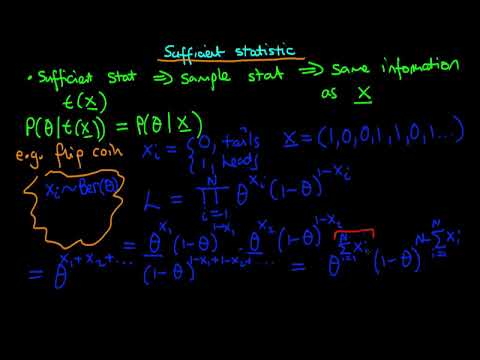
In technical terms, when we say that a statistic T(X) is sufficient for parameter θ given sample X = (X1, …, Xn), we mean that knowing T(X) gives us as much information about θ as knowing the entire dataset. Mathematically speaking, this often involves concepts like likelihood functions and factorization theorem—but don’t worry too much about that complexity right now!
The Factorization Theorem
This theorem helps identify sufficient statistics by stating that if the joint probability distribution can be factored into two parts—one depending only on your sample through T(X) and another independent part—then T(X) is indeed sufficient. Think of it like separating essential clues from background noise while solving a mystery!
A Note on Practicality
It’s also worth noting that working with these concepts isn’t just theoretical; they actually aid statisticians and researchers in making informed decisions based on real-world data analysis. However, always remember: while understanding this stuff is super helpful, nothing beats getting professional guidance when you’re deep into data science.
So there you have it! Sufficient statistics are basically about finding that key piece of info needed to interpret larger sets without getting bogged down by unnecessary details! Pretty cool concept, right?
You know what? Statistics can be a bit of a brain teaser. I mean, it’s all about understanding data and drawing conclusions from it, which sounds simple enough, but then you bump into terms like “sufficient statistic.” And honestly, when I first heard that phrase, my mind went a bit blank.
Here’s the thing: a sufficient statistic is like the ultimate sidekick for a certain type of data. Imagine you’re at a party surrounded by a bunch of friends, and you want to tell someone about your wild weekend. You could go into every detail or just give them the highlights that capture the essence of what happened. That’s kind of how sufficient statistics work! They help summarize all the necessary information from your data without dragging along extra fluff.
Let me share an anecdote. A while back, I tried to organize my closet. It was chaos! Clothes everywhere; some I hadn’t worn in years—super unnecessary stuff cluttering up my space. So, I decided to take everything out and just keep what I actually wore regularly or that sparks joy (thanks for that advice Marie Kondo!). In the end, I ended up with just my favorite pieces neatly hung up. That’s like finding a sufficient statistic! Instead of drowning in all that fabric (data), I focused on what really mattered.
But why does it matter? Well, because sufficient statistics make life easier in statistical inference—the process of making judgments about a population based on sample data. They give researchers key insights without overwhelming them with noise from irrelevant info. It’s pretty cool how much you can learn from focusing on those core elements.
All in all, when you’re dealing with data and trying to figure out what’s actually significant, leaning on those sufficient statistics means you’re cutting through the clutter to get right to the point—like me tossing out those shirts I’d forgotten about! So next time you’re knee-deep in numbers or some kind of analysis, remember: finding your “sufficient statistic” might just save you from drowning in details and steering you toward clearer conclusions.