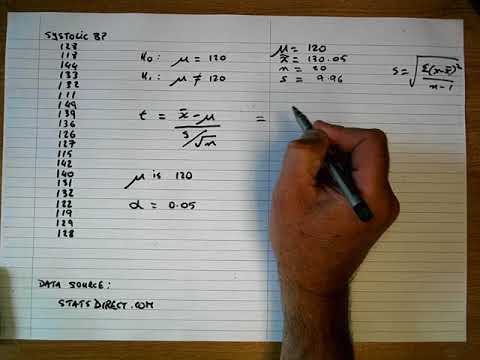
Hey! So, let’s talk about something that might sound a little fancy but is actually pretty cool: the one sample t-test. You know what? It’s one of those things that can help you figure out if your group’s average really stands out from a specific number.
Este blog ofrece contenido únicamente con fines informativos, educativos y de reflexión. La información publicada no constituye consejo médico, psicológico ni psiquiátrico, y no sustituye la evaluación, el diagnóstico, el tratamiento ni la orientación individual de un profesional debidamente acreditado. Si crees que puedes estar atravesando un problema psicológico o de salud, consulta cuanto antes con un profesional certificado antes de tomar cualquier decisión importante sobre tu bienestar. No te automediques ni inicies, suspendas o modifiques medicamentos, terapias o tratamientos por tu cuenta. Aunque intentamos que la información sea útil y precisa, no garantizamos que esté completa, actualizada o que sea adecuada. El uso de este contenido es bajo tu propia responsabilidad y su lectura no crea una relación profesional, clínica ni terapéutica con el autor o con este sitio web.
Imagine you’re in a cooking class and everyone has been raving about your chocolate chip cookies. But are they really better than the last batch? That’s where this t-test steps in to save the day! It’s all about comparing means and getting to the bottom of whether your cookies deserve that spotlight or not.
Stick around, and I’ll break it down step-by-step, just like we’re chatting over coffee. You’ll see how simple it can be! Ready for a little math magic? Let’s roll!
Step-by-Step Analysis of One Sample T-Test: Comprehensive Guide and PDF Example
Alright, let’s get into the nitty-gritty of a one sample t-test! You might be thinking, “What the heck is that?” Well, it’s actually a pretty cool statistical tool that helps you figure out if the average of a single group is different from a known or hypothesized value. So, if you’ve ever wondered whether your gaming score was above average compared to your friends’, this test can help you out!
First off, let’s break down what you actually need for this test. Here are the key components:
- Sample Data: You need a set of data points from your group. This can be anything like test scores, game scores, or even height measurements.
- Population Mean: This is the mean (average) value you’re comparing your sample against. For example, maybe you think the average score for a certain game is 50.
- Sample Size: The number of observations in your sample matters. A larger sample gives more reliable results.
- Sample Standard Deviation: How spread out your data points are around the mean is super important too!
Now that we have our ingredients, let’s get cooking!
### Step 1: Formulate Hypotheses
You need two statements to compare here:
Null Hypothesis (H0): This typically states that there is no difference between your sample mean and the population mean. For instance, “The average gaming score of my group is 50.”
Alternative Hypothesis (H1): This suggests there’s a difference. Like, “The average gaming score of my group is not 50.”
### Step 2: Calculate Sample Mean and Standard Deviation
Grab those data points and do some math! Add them up and divide by how many numbers you have to find your sample mean. For example:
If your scores are [48, 52, 55], then:
Mean = (48 + 52 + 55)/3 = 51.
Next up, calculate standard deviation. It shows how much variability there is in your scores.
### Step 3: Determine the t-Statistic
Here’s where it gets fun! You’ll use this formula:
t = (X̄ – μ) / (s / √n)
Where:
– X̄ = sample mean
– μ = population mean
– s = sample standard deviation
– n = sample size
So with our numbers plugged in:
If our population mean μ is 50 and (s) calculated to be about 3,
then t = (51 – 50) / (3 / √3) ≈ 1.73.
### Step 4: Find Critical Value or P-value
You’ll need to check out a t-distribution table or use software for this step—find critical values based on degrees of freedom and significance level (usually set at .05).
Depending on what you find here:
– If t-statistic > critical value → reject H0.
– If p-value
Step-by-Step Analysis of One Sample T-Test Using SPSS: A Practical Example
So, you’re curious about the one-sample t-test and how to do it using SPSS, huh? That’s cool! Let’s break it down step by step. Imagine you have a group of friends, and you want to know if their average gaming score is higher than, say, 50 points. Here’s how you’d tackle that using SPSS.
What is a One-Sample T-Test?
Basically, this test helps you figure out if the average (mean) of a sample group differs significantly from a known value. In our case, we’re testing if your friends’ average score is different from 50.
Step 1: Gather Your Data
First things first: you’ve gotta collect your scores. Let’s say you have the following scores from your five friends during game night:
- 55
- 60
- 45
- 70
- 50
Now you’ve got some numbers to work with!
Step 2: Open SPSS and Enter Your Data
Launch SPSS and enter these scores in a single column. Make sure each score is in its own row under something like “Scores.” It should look something like this:
| Scores |
|——–|
| 55 |
| 60 |
| 45 |
| 70 |
| 50 |
Pretty straightforward!
Step 3: Navigate to the One-Sample T-Test Function
Next up, go to the top menu and click on Analyze. Hover over Compare Means, then click on One-Sample T Test…. This will open up a new dialog box.
Step 4: Select Your Variable
In this dialog box, you’ll see a list of variables on the left. Select your “Scores” variable and move it over to the right box that says “Test Variable(s).”
Now here comes an important part!
Step 5: Set Your Test Value
In that same dialog box, there’s a field labeled “Test Value.” This is where you’ll type in the value you’re comparing against—in our example, it’s **50**. Once that’s set, hit If any buttons are required to proceed; just press OK.
Step 6: Interpret Your Output
After hitting OK, SPSS will generate an output window for you. Look for a section called **One-Sample Statistics**; this will show you the mean of your friends’ scores along with other details like sample size and standard deviation.
Then check out **One-Sample Test** table! You’ll see:
- The mean score (which should give an insight into their performance).
- A t-value (this tells you how far your sample mean deviates from your test value).
- The degrees of freedom (which is linked to your sample size).
- A p-value (this indicates whether or not there’s statistical significance).
If your p-value is less than .05—woah! That means there’s a significant difference between your friends’ average score and the test value (50 points). Otherwise? Well, they’re just about average gamers. No offense intended!
A Little Emotional Anecdote!
Once upon a game night—friend A didn’t quite believe he could beat his usual high score of just scraping by at around 49 points. After we crunched some numbers with this t-test method? Turns out he was doing way better than he thought! Encouraging him really changed his gaming vibe.
So there you have it—a simple breakdown of how to conduct a one-sample t-test using SPSS! Remember though; while stats can guide decisions in casual gaming or life choices, they’re not everything. Always consider reaching out for professional help when needed!
And hey—good luck with those game nights!
One Sample T-Test: Example Problems and Detailed Solutions for Statistical Analysis
So, you’re curious about the one-sample t-test? That’s a solid topic! This test helps you understand if the average score of your sample differs significantly from a known value, like a population mean. Let’s break it down step-by-step.
What is a One-Sample T-Test?
In simple terms, the one-sample t-test compares the mean of your sample to a specific value. Imagine you’ve got a game where players score points, and you want to see if the average score of your players is different from, let’s say, 100 points.
To do this test, here’s what you usually need to have:
- A sample of data
- The population mean you’re comparing against
- The number of observations in your sample
- The standard deviation of your sample
When Do You Use It?
You’d use this test when:
- You have one group and want to compare its average to a set number.
- Your data is continuous (like scores or measurements).
- The sample size is relatively small (typically less than 30).
Let’s Walk Through an Example!
Say you have data on how many hours your friends play video games per week. Let’s say their average playtime is 10 hours. You think that might be lower than the national average of 15 hours. Here’s how you’d run the one-sample t-test:
1. **State Your Hypotheses**:
– Null hypothesis (H0): The average playtime is equal to 15 hours.
– Alternative hypothesis (H1): The average playtime is not equal to 15 hours.
2. **Collect Your Data**:
– Let’s say you surveyed 12 friends and gathered these weekly playtimes:
– 8, 10, 9, 14, 11, 7, 12, 13, 6, 10, 9, and 15.
3. **Calculate Mean and Standard Deviation**:
– Calculate the mean:
(8 + 10 + … +15) /12 = about 10.
– Calculate standard deviation using this formula:
√((Σ(x-mean)²)/(n-1)) where n is the number of observations.
4. **Calculate T-Statistic**:
Use:
T = (mean – population mean) / (standard deviation / √n).
For our example:
T = (10 – 15) / (calculated SD / √12).
5. **Find Critical Value**:
You’ll look up critical values from a t-table based on your degree of freedom which in this case would be n-1 (so df=11).
6. **Make Your Decision**:
If your calculated t-value exceeds the critical value from the table or falls in the rejection region for that significance level (usually set at .05), then you reject H0.
7. **Conclusion**:
Based on that decision-making process above you’ll say whether there’s enough evidence to believe that friends’ gaming time isn’t equal to that national average!
Final Thoughts!
Running a one-sample t-test can seem tricky at first but really it’s about comparing means and understanding variations in data! It helps give clarity in situations where we want proof behind our assumptions or guesses based on limited samples.
And remember—this info doesn’t replace professional help or advice; it merely sets up some basic understanding about statistical analysis! Happy analyzing!
You know, when it comes to statistics, sometimes it can feel a bit overwhelming, right? I mean, you probably remember sitting in class staring at the chalkboard, thinking about how all these numbers and tests apply to real life. Well, one test that often comes up is the One Sample T Test. It’s not as scary as it sounds!
Let me share a little story. A friend of mine was trying to figure out if his new morning routine actually improved his energy levels. So he decided to track his energy on a scale from 1 to 10 for two weeks before and after he started waking up early and exercising. He had all this data but didn’t really know what to do with it.
In comes the One Sample T Test! So, here’s the deal: this test helps you figure out if the average of your sample group is significantly different from some known value. In my friend’s case, that known value could’ve been his average energy level before starting that new routine.
First off, he gathered all those numbers—his energy scores before and after—and calculated the average for each period. Then he pointed out: «Wait a minute! How do I even know if this difference matters?» That’s where tracking down the standard deviation can help; it’s basically how spread out those scores are around the average.
Then there’s this thing called degrees of freedom—sounds fancy—but it’s just one less than your sample size. For my friend who tracked 14 days of energy scores…he had 13 degrees of freedom (14 – 1). Easy peasy!
Next step is finding that t-statistic; you compare your group’s mean (average) to whatever value you’re testing against — like his initial average score — while factoring in how much variation exists within those scores.
Once he crunched those numbers and got a t-value, there was this moment of anticipation: “What does this tell me?” He needed to check against a t-table or use software to find out whether that number is statistically significant based on his degrees of freedom.
If it’s greater than the critical value from the table for their chosen significance level (let’s say 0.05), bam! That means there really might be an improvement in his energy level after implementing that morning routine.
The emotional payoff for him came when he realized—“Wow! This isn’t just me feeling good; there’s actual proof here!” It significantly boosted his confidence too because now he knows what works for him—and honestly, isn’t that something we all want?
So remember friends, while statistics can seem dull or confusing at first glance—there’s usually some sense-making behind them once you dig deeper! Plus, who doesn’t love finally getting answers from all those numbers?