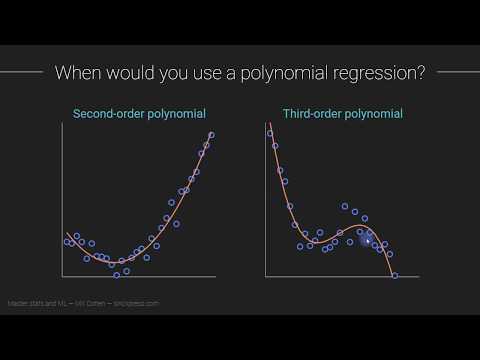
Hey there! So, let’s talk about this thing called polynomial regression. Sounds fancy, right? But it’s really just a way to make sense of data when things start to get a bit… well, twisty.
Este blog ofrece contenido únicamente con fines informativos, educativos y de reflexión. La información publicada no constituye consejo médico, psicológico ni psiquiátrico, y no sustituye la evaluación, el diagnóstico, el tratamiento ni la orientación individual de un profesional debidamente acreditado. Si crees que puedes estar atravesando un problema psicológico o de salud, consulta cuanto antes con un profesional certificado antes de tomar cualquier decisión importante sobre tu bienestar. No te automediques ni inicies, suspendas o modifiques medicamentos, terapias o tratamientos por tu cuenta. Aunque intentamos que la información sea útil y precisa, no garantizamos que esté completa, actualizada o que sea adecuada. El uso de este contenido es bajo tu propia responsabilidad y su lectura no crea una relación profesional, clínica ni terapéutica con el autor o con este sitio web.
You know how sometimes life doesn’t just go in straight lines? Like, your favorite coffee shop’s sales might spike in the winter but drop in the summer. That’s where polynomial regression steps in to save the day!
We’re gonna explore some cool techniques and real-life applications of this method. Don’t worry, it won’t be boring math stuff! I’ll keep it fun and super relatable. Stick around; I promise you’ll see data in a whole new light!
Exploring Practical Applications of Regression Analysis in Everyday Decision Making
Regression analysis might sound like something you’d find in a math class, but believe me, it’s way more exciting than that! It’s like having a secret weapon for making decisions in everyday life. Let’s get into that, shall we?
So, what is regression analysis? At its core, it’s a statistical method used to understand the relationship between variables. For example, let’s say you’re trying to figure out how much sleep affects your performance on video games. Regression can help you see if players who sleep more tend to get higher scores.
Now, polynomial regression takes this up a notch. Instead of just looking at straight lines—think of it like connecting dots with a ruler—it lets you curve the line through the points. This is super handy when relationships aren’t linear. For instance:
- If you’ve ever seen those crazy roller coasters that twist and turn, that’s kind of what polynomial regression does with data.
- You can model things like how your energy levels fluctuate throughout the day based on different factors.
But why should you care about all this? Well, here are some practical applications of regression analysis in everyday decision-making:
- Personal Finance: You might want to predict your monthly expenses based on previous months’ spending patterns. Regression can help project future costs.
- Health Tracking: If you’re trying to lose weight or gain muscle, analyzing your diet and exercise data through regression could show you what strategies work best for your body.
- Time Management: Got a busy schedule? You can analyze how different activities affect your productivity and make adjustments to maximize efficiency.
Imagine Jane, who’s trying to decide which gym routine gives her the best results. By using polynomial regression on her past workout data versus her weight loss progress over time, she might discover that high-intensity workouts mixed with cardio yield better results than just running alone.
In terms of gaming—a passion for many—if game developers want to tweak their games for maximum fun factor? They could use polynomial regression to analyze player engagement over time and adjust difficulty levels accordingly.
Caveats! While this approach is powerful, remember it doesn’t replace professional help when needed—whether that’s financial advice or health guidance—it’s simply a tool to aid those decisions.
In short, polynomial regression is like having an insightful friend who helps you connect the dots in life! Want better insights into your decisions? This might just be your go-to trick.
Comprehensive Guide to Polynomial Regression: Understanding Its Applications and Benefits in Data Analysis
I get it; dealing with polynomial regression can feel like trying to decipher a secret code sometimes. But, let’s break it down together in a friendly way!
Polynomial regression is really just a fancy term for a method you can use when you want to model the relationship between variables, especially when that relationship isn’t quite a straight line. Think of it like drawing a curvy path instead of just a straight road. You know how in video games, sometimes the paths twist and turn instead of going straight ahead? That’s exactly what polynomial regression helps us do with data.
What is Polynomial Regression?
In simpler terms, polynomial regression helps us fit a curve to our data points instead of just using a line with linear regression. By using polynomials (which are mathematical expressions involving powers of variables), we can capture more complex trends in our data.
Imagine you’re tracking your progress in a game—maybe how long you played each day versus your high scores. If you plot that on a graph, some days might show huge improvements while others don’t seem to change much. A straight line wouldn’t do justice to those ups and downs, right? In this case, using polynomial regression helps create that better curvy fit.
When to Use It?
There are times when linear models just don’t cut it—like when:
- Your data has curvature.
- You want to capture more complicated relationships.
- The trend is not constant over the range of your data.
For instance, if you’re looking at how fatigue influences gaming performance over long play sessions, you’ll likely need something more than just linear trends.
Applications in Data Analysis
So why should you care about this? Here are some applications where polynomial regression shines:
- Economics: Modeling supply and demand curves.
- Biology: Fitting growth curves for populations or species.
- Sociology: Analyzing survey results that may have nonlinear patterns.
- Marketing: Understanding customer trends over time or predicting future behaviors based on past data.
Now, each application uses the same concept but applies it differently based on what they need to figure out! Like different strategies in various gaming genres.
The Benefits
Alright, let’s talk perks! Why go through the effort? Here are some benefits:
- Bigger Flexibility:You can fit curves of different shapes and sizes!
- Caught Trends:If there’s an underlying trend that’s nonlinear, this will help expose it.
- Simplified Explanation:A well-fitted polynomial model can help explain complex relationships easily!
Take an example from sports analytics: if you’re analyzing player performance throughout the season, their stats might improve gradually at first and then plateau or even decline. A simple line wouldn’t show all those shifts as accurately as polynomial regression could!
The Catch
But here’s the thing: be careful! Just because we can fit curves doesn’t mean we should always go wild with degrees (that’s how many powers we use). Higher-degree polynomials can lead to overfitting—where your model looks great on paper but fails in real life because it just memorizes noise rather than capturing genuine trends.
And guess what? Polynomial regression ain’t everything—you gotta know what other tools are out there too!
So remember as you’re stepping into this world of data analysis: polynomial regression is super useful for capturing complex relationships but also requires careful handling. If you’re ever curious about applying these concepts deeper or finding professional advice catered to your situation—don’t hesitate to reach out! We’re all learning here together, right?
Mastering Polynomial Regression with Scikit-Learn: A Step-by-Step Guide
I get it, polynomial regression sounds like a fancy way to make sense of data using curves rather than just straight lines. It can totally be a game-changer in your analytics toolkit. So, let’s break this down into what you need to know without all the fluff.
First up, **what is polynomial regression?** Picture this: you’re trying to predict a player’s performance over time in a video game. If you just use a straight line (linear regression) to model it, you might miss the nuances—like performance spikes and downward trends. Polynomial regression lets you fit a curved line instead, capturing those ups and downs more accurately.
Now onto **how do you do it using Scikit-Learn?** Here’s a step-by-step breakdown:
1. Import Libraries:
You’ll need NumPy for numerical operations and Matplotlib for plotting, along with Scikit-learn for the regression itself.
«`python
import numpy as np
import matplotlib.pyplot as plt
from sklearn.preprocessing import PolynomialFeatures
from sklearn.linear_model import LinearRegression
«`
2. Prepare Your Data:
Say you collect data on player levels and scores. You’ll want your features (inputs) in an array.
«`python
# Example data: levels vs scores
X = np.array([[1], [2], [3], [4], [5]])
y = np.array([1, 4, 9, 16, 25]) # This is like perfect scoring!
«`
3. Transform Your Features:
Here’s where polynomial features come into play! You decide how complex you want your model to be—more levels of ‘power’ means more flexibility.
«`python
poly = PolynomialFeatures(degree=2)
X_poly = poly.fit_transform(X)
«`
4. Fit The Model:
Now you create an instance of LinearRegression and fit your transformed features.
«`python
model = LinearRegression()
model.fit(X_poly, y)
«`
5. Make Predictions:
Time to see what the model churns out! You can even predict scores for new levels here.
«`python
predicted_scores = model.predict(X_poly)
«`
6. Visualize The Results:
Plotting helps visualize how well your polynomial model fits compared to what’s actually happening!
«`python
plt.scatter(X, y, color=’red’)
plt.plot(X, predicted_scores, color=’blue’)
plt.title(‘Polynomial Regression Fit’)
plt.show()
«`
So with those steps locked down, what’re some **techniques and applications?**
- Feature Scaling: Sometimes scaling your data can help improve accuracy.
- Error Analysis: Analyze residuals (the differences between predicted and actual values) to tweak your model.
- Applications in Gaming: Beyond just player scores; think about predicting item prices or game sales over time.
It’s super cool how polynomial regression opens up new ways to analyze complex data relationships that aren’t linear at all! Just imagine trying to predict how much players enjoy different aspects of gameplay—totally non-linear!
Remember that while this guide gives you the tools to get started on polynomial regression using Scikit-Learn, diving deeper into stats or machine learning can only enhance your skills further. And if things get complicated or don’t seem right? Seriously consider talking to a pro—it’s always okay to seek help when needed!
You know, polynomial regression analysis might sound like something only math geeks get excited about, but it’s actually pretty cool once you break it down. So, basically, it’s a way to model relationships between variables where the relationship isn’t just a straight line. You’ve got curves involved! Think of it like listening to your favorite song—the melody weaves and dips instead of sticking to just one note.
Now, let me tell you a little story. One summer, I decided to try my hand at gardening. I planted some tomatoes and tried tracking how much they grew each week based on the amount of sunlight they got. At first, I thought more sun meant more growth—totally logical, right? But then I noticed that after a certain point, too much sun actually started stunting their growth. If only I had known about polynomial regression back then! Instead of just drawing a straight line through my data (like too many folks do), I could’ve modeled that curved relationship with my plants.
In reality, polynomial regression lets us fit a curve to data points that might not fit neatly onto a straight line. This is super handy in fields like economics or biology where those relationships can get complicated. You might see it used for predicting sales over time or analyzing how different factors impact health outcomes.
So how does it work? Well, instead of just plugging numbers into an equation like you would with linear regression (that’s where you’re looking for that straight-line relationship), polynomial regression allows you to add powers of your independent variable—a fancy way of saying you’re drawing curves by incorporating squared or cubed terms!
But wait—don’t get too carried away. Using high-degree polynomials can lead to overfitting; that’s where your model captures the noise in the data rather than the actual trend. It’s like trying too hard to impress someone by wearing all your favorite clothes at once; sometimes less is more!
All in all, while polynomial regression analysis can be pretty complex under the hood, its ability to capture real-world relationships makes it invaluable across various applications—from predicting trends based on historical data to understanding scientific phenomena. So next time you’re analyzing something with its ups and downs—not just linear stuff—consider checking out those curves! Seriously; there could be some hidden gems waiting for you there.


